
How Ted Kaczynski Became the Unabomber and What Netflix’s ‘Unabomber’ Gets Right


The term Unabomber has lingered in American true crime for years, yet many are unaware of its origins. Netflix’s latest drama explores Ted Kaczynski’s journey from a Harvard prodigy and test subject to the infamous Unabomber, as the FBI works tirelessly to track him down. This narrative directly addresses how a reclusive mathematician became a name known to many.
The story behind the Ted Kaczynski Unabomber moniker is less enigmatic than the man himself. It originated as a piece of government shorthand and evolved into one of the most recognizable nicknames in criminal history. With the film now available for streaming, it’s worth examining how this label was created and how the movie portrays it.
The nickname was birthed within law enforcement circles. Postal inspectors and agents from the FBI and ATF formed the UNABOM Task Force, combining the terms university and airline bomber. The media then transformed this internal designation into the more catchy name that the public came to recognize.
This naming was linked to the bomber’s initial targets. Following attacks at two Illinois universities and one on an American Airlines cargo hold in 1978 and 1979, Kaczynski was dubbed the Unabomber by an FBI-led task force. Essentially, the label reflected a pattern that investigators believed they could identify before knowing who was behind the attacks.
Filmmaker Elliott Halpern, who contributed to a docuseries on the case, explained to Oxygen.com that the FBI utilized the UNABOM identifier to reference the bombings targeting universities and airlines. This seemingly minor detail illustrates how a bureaucratic case file title transitioned into headlines and became ingrained in public consciousness.
The investigation itself was monumental. The UNABOM task force eventually expanded to over 150 full-time investigators, analysts, and support staff. The case spanned nearly two decades, which significantly contributed to the nickname’s deep-rooted presence in the public’s mind.
Kaczynski was also notably meticulous. His explosives were expertly crafted, and the wooden boxes used to contain them were sanded to remove fingerprints. Investigators even discovered a signature detail, as one piece of shrapnel bore the letters FC etched into its surface.
The breakthrough in the case came not from the hardware but from the written word. In 1995, the Unabomber sent a manifesto of approximately 35,000 words to the FBI, which was subsequently approved for publication by the Attorney General and FBI Director. This led Linda Patrik to recognize the ideas in the writings, prompting her to persuade her husband, David Kaczynski, to inform the FBI about his brother.
The arrest occurred quietly. Agents surrounded a small cabin in Montana and apprehended Kaczynski on April 3, 1996. The man who had sparked one of the longest manhunts in American history was finally identified, yet the nickname he earned in the early days remained unchanged.
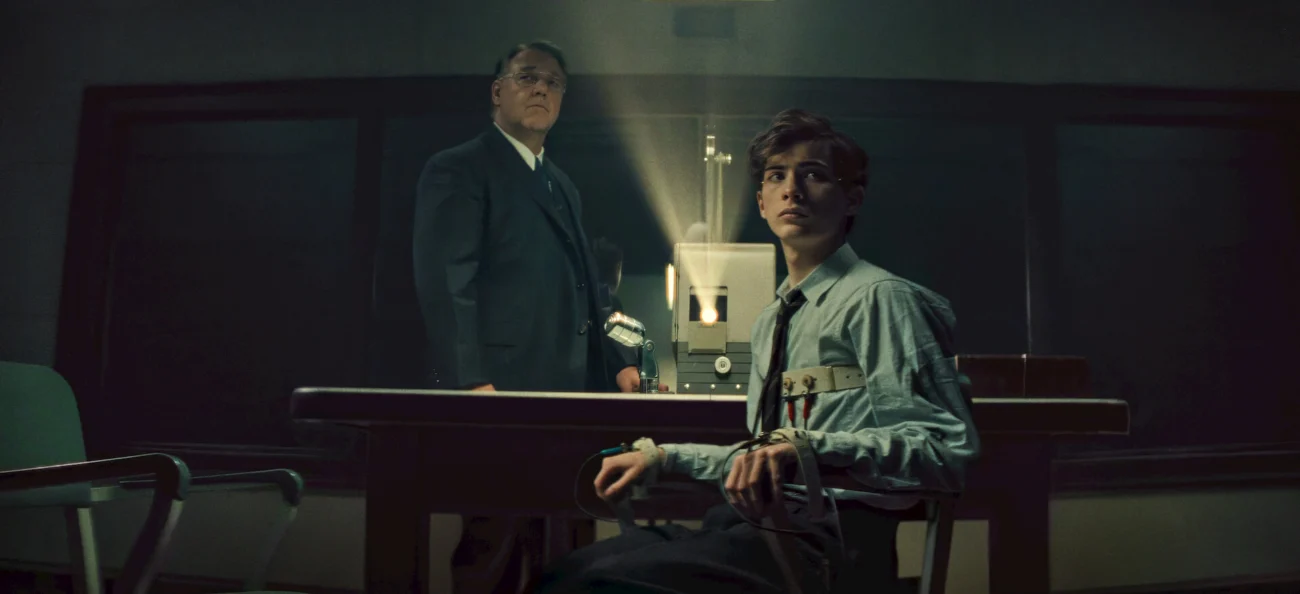
Directed by Janus Metz, Netflix’s film takes a unique approach rather than following a straightforward procedural format. It alternates between Kaczynski’s struggles to fit in at Harvard and the investigation led by FBI agent Joanne Miller, portrayed by Shailene Woodley. Russell Crowe plays the renowned psychologist Henry Murray, providing a strong anchor for the Harvard scenes.
The screenwriters found their inspiration in an unexpected source. Writer Nelson Greaves shared with Netflix that he learned from a brief NPR anecdote about Kaczynski’s time at Harvard and his involvement in unethical psychological experiments. This insight became the emotional core of the narrative.
Critical reception has been varied. Variety labeled it a clichéd Netflix remake, criticizing Jacob Tremblay’s portrayal of the teenage Kaczynski. Conversely, others offered more favorable reviews, with Heaven of Horror awarding it three out of five stars and praising Tremblay’s performance as a young Kaczynski.
The film leans heavily on the historical aspects of Kaczynski’s time at Harvard. The writers grounded their narrative in fact, as Kaczynski did attend Harvard in the late 1950s and participated in experiments led by Professor Henry Murray. However, the creative liberties taken with those experiments are where the film diverges from reality.
Even the director is cautious not to exaggerate the connections. TIME quotes Metz stating, “There are many factors in Ted Kaczynski’s life that contributed to his evolution.” This caution is significant, as the film could easily be interpreted as attributing a single cause to the subsequent events.
The movie also clarifies that it is not a comprehensive biography. Metz mentioned that the film presents a cinematic interpretation of Kaczynski’s story, offering a glimpse into his mind rather than a complete life account. For viewers seeking straightforward facts, the real timeline connects the university and airline targets to the nickname that remains in use today.
This disparity between the actual case and the dramatized origin story is what fuels debate about the film. Does a Harvard backstory provide insight into the Unabomber, or does it risk transforming a killer into a puzzle to be solved? Where should the line be drawn in a film like ‘Unabomber’?