
‘Seven Years in Tibet’ Released 28 Years Ago and Led to Brad Pitt’s China Ban


Few Hollywood films have stirred as much diplomatic controversy as this mountaineering drama. By the late 1990s, Brad Pitt had already established himself as a major movie star, but his next project would turn him into an unwelcome figure in one of the largest film markets globally. That film, ‘Seven Years in Tibet’, is remembered for its political implications as much as its cinematic qualities.
Directed by Jean-Jacques Annaud, the film was an ambitious project with a substantial budget and a grand scale. It tells a sweeping biographical tale centered around an unexpected friendship between a mountaineer and a young spiritual leader. When it finally premiered, the reaction from Beijing was immediate and severe.
The film debuted commercially in the U.S. and Canada on October 8, 1997, following its premiere at the Toronto International Film Festival the previous month. While some sources cite a slightly different release date, the October 8 date is the most commonly referenced in discussions of its opening. The film runs for 136 minutes and was produced with a budget of $70 million.
Based on the memoir of Austrian mountaineer Heinrich Harrer, the story follows Harrer, portrayed by Pitt, as he escapes a prisoner-of-war camp in British-ruled India during World War II alongside fellow climber Peter Aufschnaiter, played by David Thewlis. The duo embarks on a perilous journey across the Himalayas, ultimately reaching Tibet, which was largely inaccessible to outsiders at the time. In Lhasa, Harrer becomes a tutor and friend to the young 14th Dalai Lama, played by Jamyang Jamtsho Wangchuk, until the Chinese invasion disrupts their lives.
The film’s depiction of the Chinese takeover was unacceptable to Beijing. The Chinese government criticized it for portraying Communist officers as rude and arrogant and for presenting the Dalai Lama positively. Consequently, Pitt, Thewlis, and Annaud were banned from entering the country, and Sony’s future films faced similar restrictions.
This was a significant consequence for a studio drama. Reports indicated that the dispute jeopardized Sony’s broader business interests in China, although the company resumed operations there the following year. Notably, the film was never screened in China.
The pressure began before the film’s release. Initially, the production intended to film in Ladakh, India, but relocated to Argentina after Chinese authorities pressured the Indian government, which allegedly threatened to cut off electricity to the set and blocked a bank account associated with the film. Additional footage was filmed in Nepal, Austria, and Canada.
Annaud later revealed that two crews secretly filmed approximately 20 minutes of footage in Tibet itself. The score, composed by John Williams and featuring a cello performance by Yo-Yo Ma, earned a Golden Globe nomination. Pitt received recognition as well, winning a Rembrandt Award for Best Actor, although he also received a Stinkers nomination for his accent.
Financially, the film performed decently, grossing around $131.5 million worldwide, with about $38 million from North America. Audience reactions were generally favorable, awarding it an A- CinemaScore.
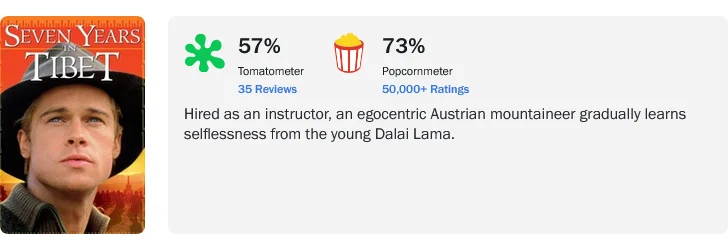
Critics had mixed opinions. The film holds a 58% rating on Rotten Tomatoes and a 55 on Metacritic, indicating a divided response. Roger Ebert rated it 2.5 out of 4 stars, arguing that the story was told from the wrong character’s perspective, while Variety praised the production values but desired more emotional depth.
The film also faced criticism for its portrayal of its protagonist. The real Harrer was an SS non-commissioned officer, a fact that some argue the film downplays. Additionally, the movie introduces a storyline about his relationship with his son that is not supported by the original memoir.
This complexity has influenced the film’s legacy. It is regarded as both a remarkable visual achievement and a reminder that Hollywood biographies often gloss over uncomfortable truths.
Eventually, the restrictions eased. Annaud returned to China in 2012 to chair the jury at the Shanghai International Film Festival, and Pitt visited in 2014 and again in 2016. Reports vary on when the ban officially ended, with some suggesting it was in 2016, coinciding with the release of ‘Allied’.
For many fans, ‘Seven Years in Tibet’ remains one of Pitt’s more ambitious and distinctive performances, continuing to ignite discussions about art, politics, and the challenges of storytelling.
Have something to add? Let us know in the comments!