
Does ‘Whalefall’ Have a Post-Credits Scene? What to Know Before Leaving the Theater


Modern survival thrillers often push audiences to experience intense tension, but recent films have also trained viewers to stay seated through the credits. In a time filled with cinematic universes and franchise hints, moviegoers frequently watch the final moments of each release to see if a hidden scene awaits. With ‘Whalefall’ now in theaters, fans are understandably curious about whether there’s an extra scene after the credits.
Based on the acclaimed 2023 novel by Daniel Kraus, this gripping thriller takes viewers deep into the perilous waters off California’s central coast. The story follows a grieving scuba diver named Jay Gardiner, who embarks on a desperate quest to recover the remains of his late father from Monastery Beach. What begins as a routine dive quickly escalates into a nightmare when a 60-ton sperm whale accidentally swallows him alive, leaving him with only an hour of breathable air.
For those wondering if they should stay in the theater after the credits roll, the answer is clear: ‘Whalefall’ does not feature a post-credits or mid-credits scene. Once Jay’s intense underwater ordeal concludes and the credits begin, the story is fully wrapped up. Audiences can gather their belongings and exit without the fear of missing any surprise endings or sequel hints.
Even without additional footage, those who choose to remain through the 106-minute runtime will appreciate the dedicated crew behind this claustrophobic tale. The credits highlight the vital contributions of visual effects supervisors, divers, and stunt performers who helped bring this biological nightmare to life. Additionally, staying allows viewers to unwind while enjoying the final movements of composer Joseph Trapanese’s atmospheric orchestral score.
The choice to forgo a post-credits scene aligns perfectly with the focused narrative crafted by director Brian Duffield and author Daniel Kraus. From the outset, this project was envisioned as a self-contained exploration of human resilience, not the start of an ongoing franchise. The film gained momentum after Deadline confirmed that rising star Austin Abrams would lead this high-concept project for 20th Century Studios and Imagine Entertainment.
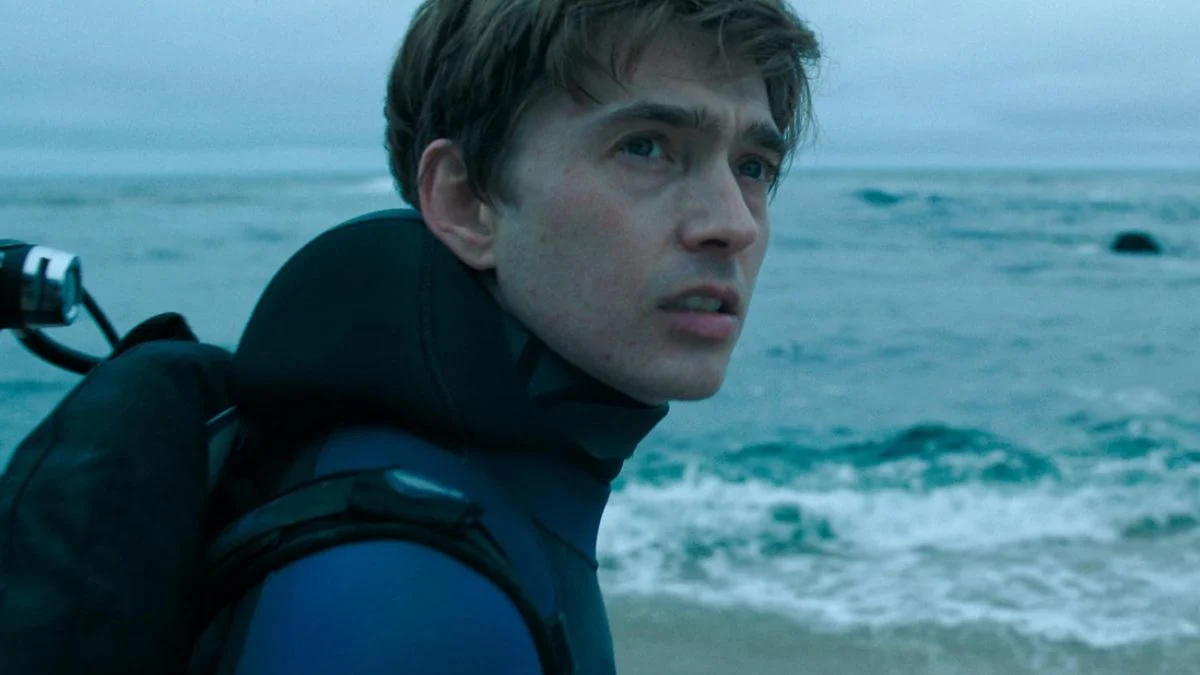
Abrams delivers a grueling, emotionally charged performance alongside veteran actor Josh Brolin, who plays Jay’s legendary diver father, Mitt Gardiner. The impressive cast also includes Elisabeth Shue, Jane Levy, and Emily Rudd, grounding the wild premise in authentic family grief. Through non-linear flashbacks reflecting Jay’s fading consciousness, the film delves into the emotional aftermath of Mitt’s tragic suicide.
To recreate the oppressive, acidic environment inside the whale, the crew built a massive, 12-foot-tall practical whale interior on a Los Angeles soundstage. Abrams spent weeks submerged in viscous fluids and confined spaces, requiring immense physical endurance for scenes where his character navigates the creature’s digestive chambers. He humorously noted that “the stomach is its own kind of diva,” in an interview with 8Days.
The decision to end without a mid-credits hook honors the thematic essence of Daniel Kraus’s original narrative. In marine biology, ‘whalefall’ describes the phenomenon where a deceased whale sinks to the ocean floor, creating a rich ecosystem that supports deep-sea life for years. Throughout the film, Jay’s struggle to survive within the whale mirrors this ecological rebirth, transforming his survivor’s guilt into a fierce will to live.
As Jay’s oxygen supply dwindles, his father’s voice resonates through the whale’s internal rhythms. Whether seen as hallucinations or a spiritual connection, these memories provide Jay with the clarity needed to escape. By confronting his trauma in the whale’s belly, he reconciles his memories of his father before fighting for his life.
Incorporating an end-credits scene or sequel tease would have undermined the emotional resolution achieved in the film’s powerful climax. Duffield allows the final imagery to resonate with clarity, giving audiences time to reflect on Jay’s harrowing journey of reconciliation. ‘Whalefall’ stands out for embracing its identity as a complete, singular cinematic experience that delivers both visceral thrills and genuine catharsis before the lights come back on.
Did the intense climax of ‘Whalefall’ keep you on the edge of your seat? Do you appreciate films that tell complete stories without post-credits teasers? Share your thoughts in the comments below!