
‘Black Phones 2’ Star Ethan Hawke Reveals How Indie Film ‘Tape’ Changed His Life


When asked which role transformed his career, fans might quickly suggest various performances by Ethan Hawke. Over the years, he has discussed numerous roles that challenged him, often praising his co-stars. In a 2021 interview, he even credited Denzel Washington with having a significant impact on his life, as highlighted in a roundup by Far Out Magazine.
However, Hawke’s latest revelation is quite unexpected. The role he now identifies as life-changing isn’t from a major studio film or an awards contender; instead, it’s from a small indie project that many casual viewers might overlook.
In a recent interview with the BBC, reported by various outlets, Hawke shared that the indie drama ‘Tape’ was pivotal in shaping his career. He described it as his entry into adult acting, arriving at a crucial time just before he turned 30. The headline from People emphasized this role’s life-altering impact, noting that it might not be the film most would anticipate.
For an actor with such an extensive career, this choice is particularly telling. Rather than highlighting a prestigious or commercially successful film, Hawke pointed to a small, experimental project that instilled confidence in him during a formative period.
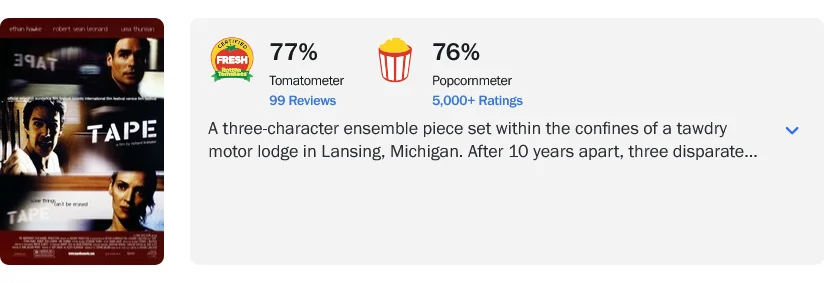
Released in 2001, ‘Tape’ was directed by Richard Linklater and adapted by Stephen Belber from his own one-act play. The narrative unfolds in real time within a single motel room, featuring Hawke as Vince, Robert Sean Leonard as Jon, and Uma Thurman as Amy. The tension escalates during a reunion among old friends, driven by a hidden tape recorder and a contentious past encounter.
The film, running for 86 minutes, was shot on digital video, a choice that Variety noted was evident throughout the production. It premiered at the Sundance Film Festival on January 26, 2001, before a wider release on November 2 of the same year.
Hawke expressed excitement about how the new digital format could revolutionize filmmaking. He acknowledged that a film set entirely in one room posed challenges, but this limitation required total dedication from the cast and crew. Reports on his BBC comments indicate that the production was completed in just six days.
This aligns with what he shared in 2001, explaining that the project stemmed from discussions with Linklater about the potential of digital filmmaking. ‘Tape’ marked their fourth collaboration, and Hawke emphasized the trust they shared, which made the experimental nature of the project feel secure. With a crew of only seven and a single location, the production was as minimalist as a feature film could be.
The film received positive reviews, holding a 77% score on Rotten Tomatoes based on 100 reviews and a 71 on Metacritic. Roger Ebert praised Hawke’s performance as brilliant, noting his commanding presence both physically and verbally throughout the film.
Variety described the film as entertaining, highlighting Hawke’s evolution as the central character, while also commending Leonard for portraying the gradual decline of his character’s confidence and praising Thurman as one of the most skilled performers on screen.
The timing of ‘Tape’s release adds another layer of significance. In 2001, it was in theaters alongside ‘Training Day’, the film that Hawke worked on with Washington and has credited with transforming his career. Experiencing both films simultaneously illustrates the breadth of his evolving range.
This context helps clarify why Hawke’s choice resonates deeply. One film placed him alongside Washington, while the other confined him to a room with two friends and handheld cameras.
It’s fitting that an actor would select a small, daring project over a more renowned credit. Hawke’s remarks suggest that the work that most profoundly influenced him was the kind that demanded everything from him as a performer, devoid of any spectacle to rely on.
For those who have only witnessed the polished aspects of his career, ‘Tape’ serves as a reminder that the roles that truly change us are not always the most ostentatious.
Have something to add? Let us know in the comments!