
Does ‘Street Fighter’ Have a Post-Credits Scene? How It Sets Up a Sequel


The recent revival of video game adaptations has turned Hollywood into a vibrant hub for iconic gaming franchises. After years of clumsy cinematic efforts and misguided translations, studios are now embracing the unique aesthetics and lore of cherished titles. With Paramount Pictures and Legendary Entertainment breathing new life into Capcom’s flagship series, martial arts cinema is once again capturing the exhilarating energy that first captivated audiences in the early 1990s.
Adapting a fighting franchise with decades of intricate backstories posed a significant challenge for the creative team. The project faced numerous obstacles during its early development, undergoing multiple script revisions and creative shifts before production finally gained traction. Longtime fans remained doubtful that any modern adaptation could redeem past live-action attempts, such as the campy 1994 film ‘Street Fighter’ and the poorly received ‘Street Fighter: The Legend of Chun-Li’ from 2009.
Production solidified after a crucial change in leadership behind the scenes. The studio altered its creative direction shortly after The Hollywood Reporter confirmed that original directors Danny and Michael Philippou left due to scheduling conflicts. Taking over, director Kitao Sakurai centered the production around a stylized 1993 setting, bringing together a diverse cast that pays homage to the spirited chaos of arcade gaming culture.
Set in 1993, the narrative follows estranged martial artists Ryu and Ken Masters as they are recruited by undercover Interpol agent Chun-Li to participate in the dangerous World Warrior tournament. Beneath the spectacle of international battles lies a global conspiracy orchestrated by General M. Bison and his paramilitary organization Shadaloo. As the climactic fights unfold, the story delivers powerful Hadoukens and devastating roundhouse kicks while hinting at ominous figures lurking in the shadows of the tournament.
The intense third act culminates in a dramatic showdown that significantly alters the competitive landscape of the fighting world. Ryu reveals a terrifying glimpse of his latent dark energy, while the demonic martial artist Akuma makes a surprise appearance to disrupt Bison’s grand plans. Instead of neatly tying up every tournament rivalry, the film intentionally leaves key plot threads unresolved as the credits begin to roll.
For those who stay through the vibrant end credits, a crucial mid-credits scene awaits. Rather than relying on a throwaway comedic moment, the film presents a significant narrative stinger that lays the groundwork for a potential sequel. This brief sequence offers immediate gratification for dedicated Capcom fans who spent the entire runtime eagerly scanning the screen for familiar champions.
Throughout the main film, traditional 2D animation is cleverly used for flashbacks, such as Ryu’s pivotal 1987 tournament match against Sagat. However, the mid-credits scene unexpectedly breaks this artistic mold by employing retro animation for an epilogue set in the present narrative. The stylized visuals evoke a gritty, hand-drawn aesthetic reminiscent of classic anime from the golden arcade era.
In this sequence, Sagat is shown training intensely in isolation, violently striking heavy wooden posts in a secluded jungle temple. He is visibly consumed by a deep-seated grudge against Ryu, glaring as sweat drips down the jagged scar on his chest, a reminder of Ryu’s decisive Shoryuken from years past. His aggressive workout is interrupted by the sound of footsteps echoing across the stone courtyard, signaling the arrival of an unexpected group.
General M. Bison enters, flanked by his deadliest operatives, including the masked matador Vega, Cammy, and the brainwashed assassin Juli. Instead of challenging the Muay Thai champion to a fight, Bison calmly extends an invitation for Sagat to join Shadaloo’s inner circle. Sagat’s brooding nod solidifies an alliance between the franchise’s most iconic villains, officially forming the core of the Four Heavenly Kings.
Sakurai explained, “Let’s look at this, the legacy of ‘Street Fighter’, and connect it to the anime, aiming for traditional 2D ’90s hand-drawn animation,” in an interview with The Movie Podcast. This deliberate stylistic choice allowed the creative team to dynamically establish Sagat’s presence without rushing casting decisions for his upcoming live-action debut.
By securing Sagat alongside Bison, the cinematic universe is well-positioned to explore the beloved storyline of ‘Street Fighter II’. Sagat’s quest for personal vengeance introduces a rich character dynamic that mirrors Ryu’s internal struggle with spiritual mastery. This intense personal conflict provides a grounded emotional counterbalance to the cataclysmic supernatural threat posed by Akuma.
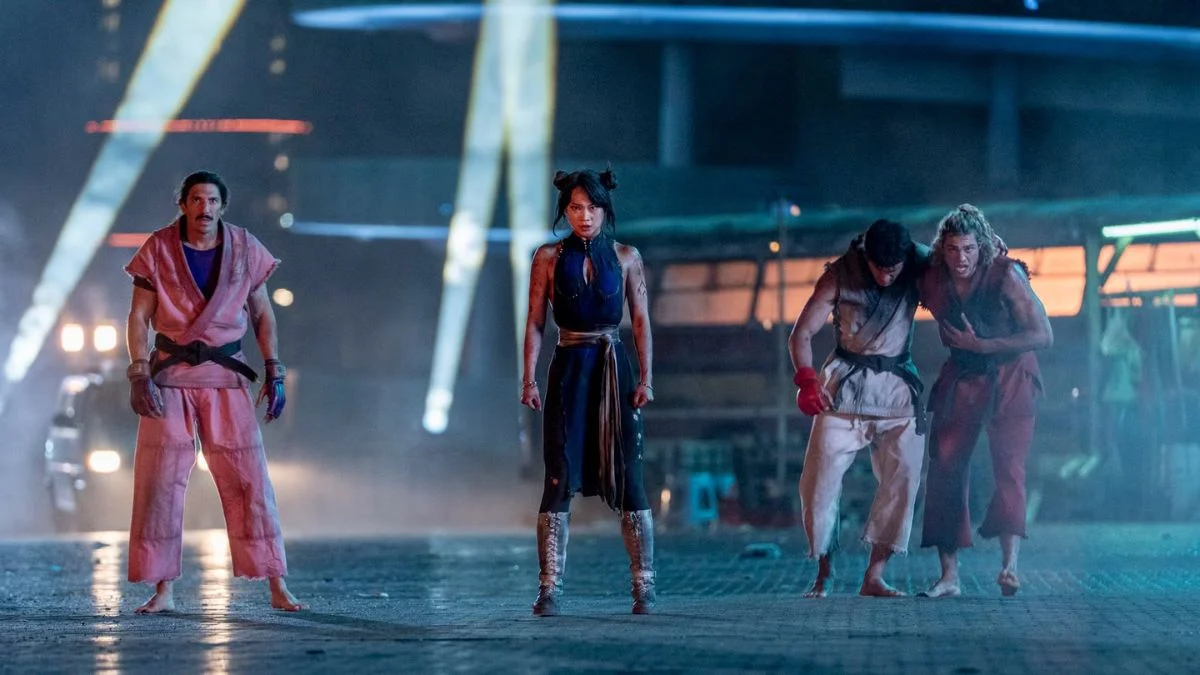
Koji shared, “My goal was to bring as much depth and nuance as possible,” speaking to Empire about immersing himself in Shotokan karate to honor Ryu’s foundational fighting style. This relentless dedication underscores why Sagat’s return will challenge Ryu’s physical restraint and psychological resolve in future installments.
Simultaneously, Noah Centineo’s Ken Masters and Callina Liang’s Chun-Li will need to navigate a fully operational Shadaloo network across global strongholds. With David Dastmalchian’s dictatorial mastermind assembling formidable allies, future confrontations will undoubtedly extend far beyond traditional tournament arenas. The tactical mid-credits sequence demonstrates that this live-action reboot is treating its rich arcade source material with genuine creative respect.
What did you think of the mid-credits scene in ‘Street Fighter’, and who would you cast as Sagat in the sequel?