
Every Character Who Dies in ‘The Odyssey’ and Christopher Nolan’s Adaptation Changes


Christopher Nolan’s blockbuster adaptation of Homer’s ancient epic has hit theaters, showcasing the director’s willingness to embrace the poem’s brutal nature. The film follows Matt Damon’s Odysseus on a decade-long journey filled with deadly encounters involving mythological creatures, vengeful gods, and treacherous suitors as he travels from Troy to Ithaca, resulting in a significant death toll both in the text and on screen.
Audiences exiting ‘The Odyssey’ are already sharing their thoughts and comparing the film to their English class readings, questioning how closely Nolan adhered to the original material. The answer is complex, as the film condenses, rearranges, and sometimes invents elements throughout thousands of years of storytelling tradition.
Nolan’s adaptation quickly reduces its cast. Odysseus loses every crew member during the harrowing ten-year journey from Troy to Ithaca, with several sailors devoured by Bill Irwin’s Cyclops Polyphemus, while others perish in various battles along the way.
The Troy sequence introduces a death that is often omitted in other adaptations. Elliot Page portrays Sinon, a soldier Odysseus deceives into staying behind at Troy as bait, necessary for persuading the Trojans to accept the wooden horse into their city, after which Benny Safdie’s Agamemnon leads the Greek army to destroy the city.
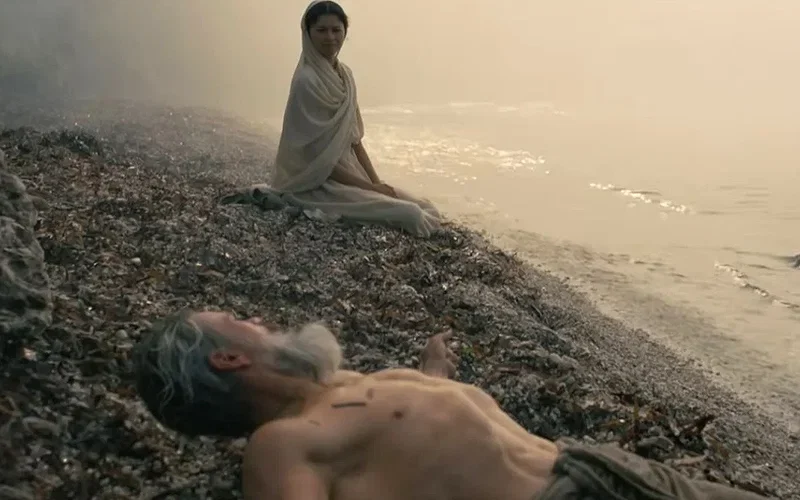
The latter part of the voyage is equally ruthless. Himesh Patel’s Eurylochus defies Odysseus by persuading the starving crew to slaughter Helios’ sacred cattle, prompting Poseidon to unleash devastating storms that destroy the last ship and drown the remaining sailors. Ryan Hurst’s Mentor and Jovan Adepo’s Elpenor also meet their end before Odysseus washes ashore on Ithaca alone.
The palace massacre concludes the bloodshed. Matt Damon’s Odysseus kills Robert Pattinson’s Antinous and Corey Hawkins’ Polybus during the suitor massacre, while Tom Holland’s Telemachus takes down Logan Marshall-Green’s Melanthius, and Mia Goth’s Melantho faces execution afterward. Even Odysseus himself is not without peril, suffering severe wounds from arrows lodged deep in his back during the chaos, leaving it ambiguous whether these injuries ultimately prove fatal for the legendary Greek king.
The poem’s massacre in Book 22 is one of the most renowned scenes in Western literature, beginning similarly to the film. The first suitor to die is Antinous, who had insulted and assaulted an elderly beggar, who was Odysseus in disguise.
Homer’s description of that first kill is much more detailed than anything seen in most trailers for ‘The Odyssey.’ Antinous is shot through the throat with an arrow while raising a golden cup to drink, a death scene that is among the most memorable in the poem, with wine and blood mingling as he collapses to the floor.
Following that, Homer continues the slaughter. Odysseus eliminates the suitors one by one with the help of his son and a few men who recognize him, leaving none of the suitors alive, although Medon and Phemius are spared, while Melanthius and the disloyal servants face execution.
Homer’s suitor pool is also significantly larger than what a modern runtime can accommodate. Antinous of Ithaca was one of the 108 suitors of Penelope, and characters like Eurymachus and Amphinomus, among the many suitors, are killed like the rest in the final confrontation, even though only a few named suitors appear on screen.
The primary structural difference lies in the scope rather than the outcome. Homer’s text spreads its violence across a vast array of unnamed sailors and over a hundred suitors, while Nolan’s script narrows the carnage to recognizable stars, allowing audiences to track who is falling.
The invented Troy prologue represents the clearest departure from the source material. Sinon’s role as bait for the wooden horse trick is Nolan’s dramatic shorthand for a backstory that Homer’s ‘Odyssey’ barely dramatizes directly, as the epic itself begins well after Troy has already fallen.
Odysseus surviving his final battle wounded rather than triumphant and unscathed is another significant twist. Nolan finds a way to conclude the ancient story with a fresh plot twist, and the ambiguous, potentially fatal ending for its hero has become one of the most discussed choices in the entire production.
The film relies on a large ensemble to convey this bloodshed. Nolan’s adaptation features Matt Damon as Odysseus, king of Ithaca, alongside Anne Hathaway as his wife Penelope, who strives to maintain peace in her home while fending off a horde of suitors with the help of her son Telemachus, played by Tom Holland.
Zendaya adds to the divine aspect of the story as the goddess guiding Odysseus through his trials, while Robert Pattinson plays the scheming suitor Antinous, who plots to take control of Ithaca during Odysseus’s absence. The supporting cast includes Charlize Theron’s Circe and Lupita Nyong’o, giving nearly every major mythological figure a recognizable face.
This star power is part of why the deaths resonate so strongly. Witnessing a beloved actor fall during the suitor massacre carries a different emotional weight than reading a name in translated verse, and that emotional gap is precisely what Nolan seems to be banking on.
Between Homer’s extensive body count and Nolan’s streamlined, star-studded version of the same bloodshed, which telling of Odysseus’s homecoming do you believe earns its conclusion, the poem’s triumphant restoration or the film’s haunting uncertainty about whether its hero even survives?