
‘Whalefall’ Ending Explained: Does Jay Escape the Belly of the Beast?


Survival thrillers have long fascinated audiences by pushing human endurance to its limits. From the depths of the ocean to isolated desert landscapes, this subgenre excels at transforming confined spaces into emotional pressure cookers. These narratives explore the psychological weight of isolation and the visceral terror of nature, peeling back the layers of the human psyche.
In his gripping 2023 novel ‘Whalefall‘, author Daniel Kraus taps into this primal fascination, which has now been adapted for the big screen by director Brian Duffield. While the film’s premise invites comparisons to maritime classics, the creative team intentionally steers clear of typical monster tropes. Instead, the story uses the vastness of the Pacific Ocean to frame a claustrophobic confrontation with guilt and familial grief.
The plot follows Jay Gardiner, an emotionally scarred diver played by Austin Abrams in the film. Haunted by guilt over his estranged father Mitt’s suicide, Jay embarks on an unsanctioned solo dive off Monastery Beach to recover his father’s sunken remains. However, a catastrophic encounter with a giant squid and an 80-foot sperm whale pulls Jay deep underwater, where he is swallowed alive with only an hour’s worth of breathable oxygen.
Trapped inside the whale’s expansive digestive tract, Jay battles darkness, corrosive fluids, and dwindling air. Director Brian Duffield emphasizes the relentless isolation of Jay’s experience over typical Hollywood spectacle. “The bulk of our movie takes place within the whale itself, and we go a really long time without cutting outside,” Duffield told TheWrap, discussing the intense staging of Jay’s claustrophobic struggle.
As Jay navigates the whale’s complex stomach, the story blurs the line between harsh biological reality and psychological breakdown. He hallucinates his father Mitt, portrayed by Josh Brolin, and begins to relive the brutal diving lessons his father imposed on him. These painful memories evolve from emotional scars into tactical strategies necessary for surviving the creature’s crushing internal pressures.
Kraus took great care to ensure the whale’s biology was rooted in marine realism rather than sensationalism. “I still think it’s highly unlikely that anyone will get swallowed by a sperm whale,” Kraus noted in an interview with Reuters, reflecting on his extensive research with whale biologists and diving experts. This meticulous attention to anatomical detail heightens the narrative tension, making each stomach chamber a genuine physical threat.
As Jay’s dive tank runs low and the whale plunges into the icy depths, he realizes that escaping through the esophagus is impossible. In a desperate move, he uses a dive light battery, steel wool, and his remaining oxygen to ignite flammable methane gas pockets within the whale’s belly. The resulting explosion severely injures Jay’s hand, but it creates a crucial pathway into the whale’s abdominal cavity.
Feeling the internal damage, the panicked leviathan surges to the surface and beaches itself on Monastery Beach. Jay fights through the whale’s massive heart, cutting through layers of blubber and muscle until he reaches the light of day. Marine scientists and horrified beachgoers, alerted by the thrashing beneath the skin, rush to slice through the carcass to rescue Jay.
While Jay survives against overwhelming anatomical odds, he emerges from the ocean without the one thing that drove him there: his father’s remains. Mitt’s bones remain undisturbed on the ocean floor, forever out of reach for the son who spent a year grappling with unspoken apologies. Jay ultimately learns that true closure cannot be extracted from the depths but must be chosen through the conscious decision to continue living.
The film’s conclusion transforms the biological term ‘Whalefall’ into a poignant metaphor for grief, legacy, and healing across generations. In marine ecology, a whale fall occurs when a dead whale sinks, creating a rich ecosystem for years. Mitt’s death serves not as a burden to drown Jay but as the difficult nourishment that empowers him to endure and grow.
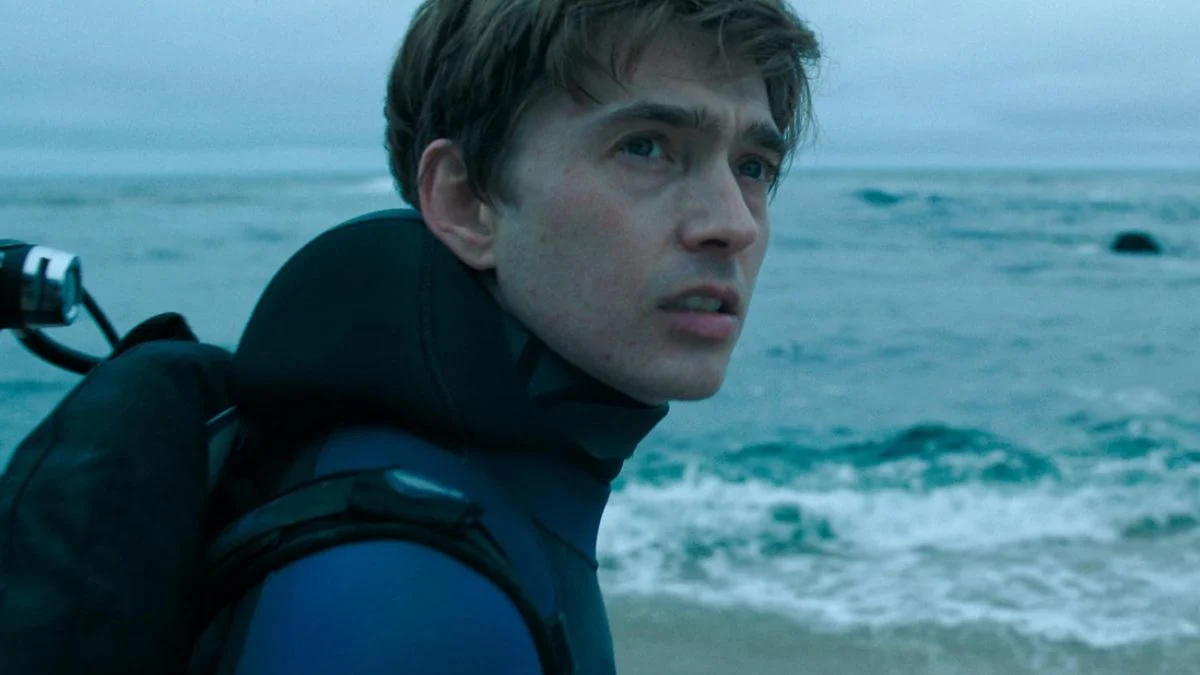
Jay’s emergence from the belly of the beast symbolizes a violent rebirth that liberates him from self-punishment. Though he bears permanent injuries, he finally lets go of his resentment and reclaims his place with his mother and sisters. By carrying his father’s lessons without succumbing to his father’s tragedy, Jay transforms a horrific aquatic tomb into a sanctuary of renewed purpose.
Share your thoughts on the intense ending and emotional themes of ‘Whalefall’ in the comments below!