
The Academy Museum Revives the Original ‘The Blair Witch Project’ Website for New Horror Exhibit


Few horror films have blurred the lines between fiction and reality like ‘The Blair Witch Project’. Before the movie even hit theaters, audiences were led to believe that three student filmmakers had disappeared in the Maryland woods, and many were convinced of its authenticity.
Much of that illusion was crafted online. Directors Daniel Myrick and Eduardo Sánchez launched the original website in June 1998, presenting the Blair Witch as a genuine urban legend. The site was filled with fabricated historical documents, eyewitness accounts, and news interviews regarding the missing students.
Now, that once-lost piece of internet history has been resurrected. The Academy Museum has recreated the original promotional website for ‘The Blair Witch Project’, complete with a 53-second clip of the site displayed on a vintage CRT monitor. This recreation is part of the museum’s new horror exhibition, allowing visitors to explore it firsthand.
The Academy Museum has recreated the original promo website for ‘THE BLAIR WITCH PROJECT’. pic.twitter.com/KuD8aszhDK
— DiscussingFilm (@DiscussingFilm) September 24, 2026
The site serves as a centerpiece in the Ghosts chamber of ‘The Horror Show’. This space is designed like a haunted living room where guests can navigate the original marketing website. It also showcases artifacts from ‘The Conjuring’, ‘The Monkey’, ‘Poltergeist’, ‘The Ring’, and ‘Talk to Me’.
The museum pairs these items with historic Japanese woodblock prints and theatrical release posters from the 1960s and ’70s, highlighting the significance of ghost stories in Japanese culture. Since the original site has been taken down for years, this is a rare opportunity to see it as it once was. It’s a creative approach to transforming a piece of internet history into an immersive experience.
The website was crucial to a marketing strategy that marked a significant shift in the industry. Around the same time, the Sci-Fi channel aired a mockumentary titled ‘Curse of the Blair Witch’, which portrayed the legend as real and the students as genuinely missing. Filmmakers even distributed missing person flyers at screenings.
The results speak for themselves. By August 1999, the site had amassed 160 million hits, and Artisan reportedly invested around $25 million into the campaign. This is a staggering amount for a film with an original budget of $35,000 to $60,000, ultimately costing between $200,000 and $750,000 after post-production and marketing.
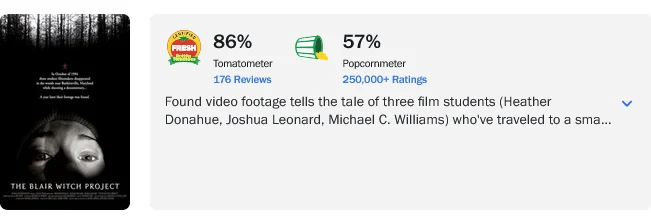
The financial return was monumental. The film grossed $248.6 million, making it the fifth highest-earning independent film of all time. Its blend of found footage and internet-driven mystery revitalized the found-footage genre, influencing later hits like ‘Paranormal Activity’, ‘Rec’, and ‘Cloverfield’.
‘The Horror Show’ opens on September 26 in the Academy Museum’s fourth-floor Marilyn and Jeffrey Katzenberg Gallery and will run through July 25, 2027. The exhibition is organized around six themed chambers: Gothic, Psychological, Science, Slasher, Religion, and Ghosts. The only exit is through The Blood Room, an immersive space with gallery walls adorned in cinematic gore.
The exhibition features hundreds of original artifacts, costumes, props, and production materials. Highlights include Bela Lugosi’s restored cape from ‘Dracula’, original ‘Psycho’ storyboards, and costumes and props from ‘Alien’, ‘Get Out’, ‘Halloween’, ‘The Exorcist’, and ‘The Silence of the Lambs’. The advisory team includes Willem Dafoe, ‘Longlegs’ director Osgood Perkins, and Oscar-winning makeup artist Howard Berger.
A full schedule of programming accompanies the exhibition. It kicks off on September 26 with the retrospective ‘John Carpenter: Prince of Darkness’, followed by an all-ages Monster Mash on October 24 and a 21-plus Museum After Dark party on Halloween night. A 50th anniversary screening of ‘Carrie’ with Sissy Spacek in attendance is set for November 19.
The timing is serendipitous. A new version of ‘The Blair Witch Project’ is slated for release in September 2027, helmed by filmmaker Dylan Clark, who began his career on YouTube. Experiencing the original website in a museum context serves as a reminder of how groundbreaking the initial marketing campaign was.
It also illustrates how museums are recognizing internet culture as a vital part of film history. A promotional site that once deceived a nation now stands alongside classic props and costumes, making it a fitting tribute to one of the most innovative horror marketing strategies ever.
Have something to add? Let us know in the comments.