
The Truth Behind ‘Remarkably Bright Creatures’ And The Viral Octopus Inspiring Marcellus


Netflix viewers who were captivated by Tova, Cameron, and one particularly grumpy giant Pacific octopus over the weekend are naturally curious. Is ‘Remarkably Bright Creatures’ based on a true story, or did author Shelby Van Pelt simply create the most charming eight-armed narrator in recent times?
The short answer is that the film, which debuted on Netflix on May 8, is not based on real individuals or events. The longer answer involves a viral YouTube video, a creative writing exercise, and an author with a passion for aquariums who let her imagination dive into the tank with Marcellus.
Despite the authentic feel of Sowell Bay and the depth of Tova Sullivan’s sorrow, the narrative is entirely fictional. The novel was published by Ecco in May 2022 and quickly became a New York Times bestseller, but the quaint Pacific Northwest town and its aquarium exist only in the book and now on screen.
This hasn’t stopped readers from assuming otherwise. Librarians have reported frequent inquiries about whether the book is nonfiction, largely due to the accurate cephalopod science woven into Marcellus’ chapters. Real octopuses can indeed unscrew jars, recognize human faces, and execute daring escapes from their tanks, which adds an unsettling believability to Marcellus.
The film follows that same blueprint. Directed by Olivia Newman and co-written with John Whittington, it features Sally Field as Tova, Lewis Pullman as Cameron, and Alfred Molina voicing Marcellus, with Joan Chen, Colm Meaney, Kathy Baker, Beth Grant, and Sofia Black-D’Elia completing the Sowell Bay ensemble.
The inspiration for the novel originated from a single internet rabbit hole. In an interview with the Seattle Times, Van Pelt recalled a 2015 viral video from the Seattle Aquarium featuring an octopus attempting to escape its tank, a clip that lingered in her mind and led her to delve into octopus research.
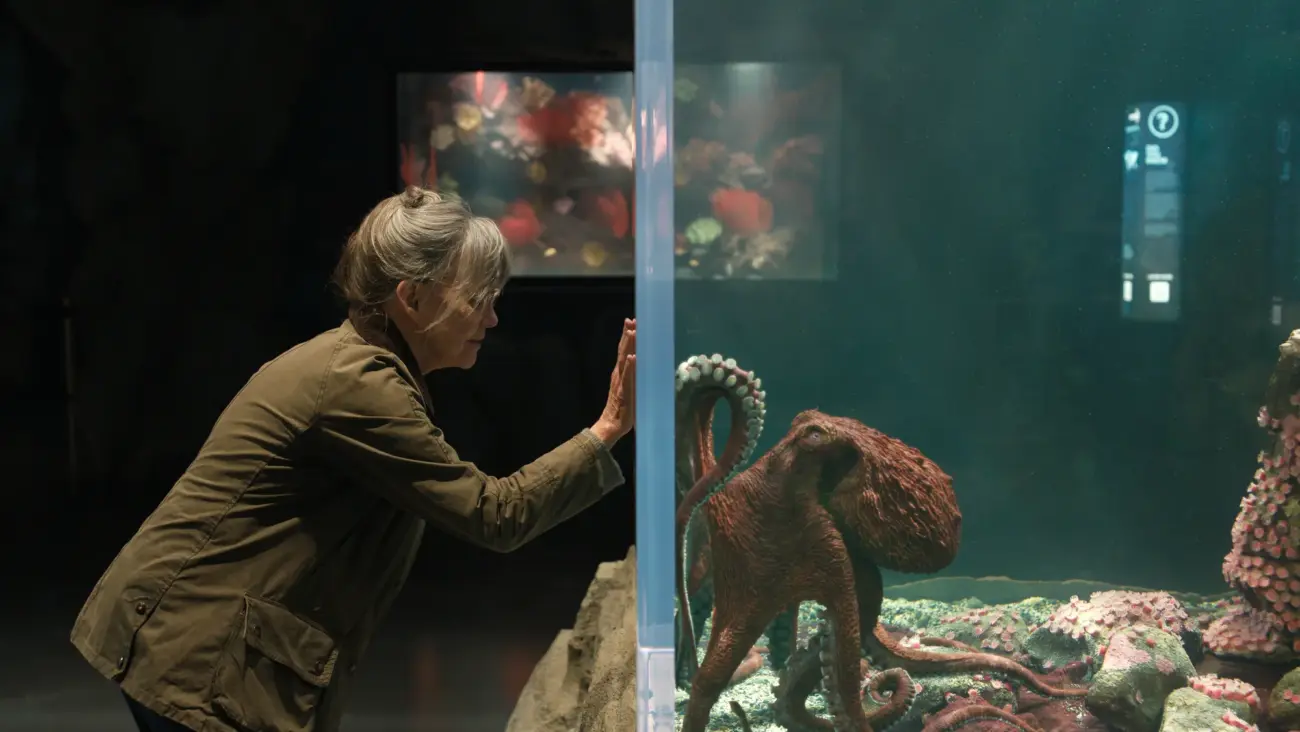
This fascination eventually merged with a creative writing class. Van Pelt mentioned that her instructor assigned the group to write from an unusual perspective, and she chose to voice the octopus lamenting its captivity by humans. She began to hear a voice in her head that was both sarcastic and frustrated, and that initial scribble transformed into the opening chapter of the book.
To keep Marcellus grounded in actual science, Van Pelt referenced nonfiction works about encounters with captive octopuses and consulted friends with marine biology expertise to ensure accuracy. The outcome is a narrator who feels remarkably believable, even when he is unlocking padlocks at midnight.
While Marcellus was inspired by the natural world, the human characters were drawn from Van Pelt’s own experiences. The author has revealed that Tova’s characteristics and outlook were based on her maternal grandmother, who played a significant role in her upbringing.
She also envisioned a specific actress for the role from the start. Van Pelt has stated that she imagined Sally Field while crafting Tova, which is why she was thrilled when Field agreed to portray the character in the Netflix adaptation. Having recently become a mother during the writing process, Van Pelt infused Tova’s long-standing grief over her son Erik with her own imagined heartbreak.
The fictional Sowell Bay Aquarium serves as a tribute to a real location. Van Pelt grew up in Tacoma, and her favorite childhood spot was the aquarium at the Point Defiance Zoo and Aquarium, where she enjoyed sitting in the dark and observing the jellyfish.
The transition from manuscript to streaming sensation was relatively swift by Hollywood standards. Netflix announced in August 2024 that it would adapt the novel, with Olivia Newman directing and Sally Field already confirmed as Tova. Principal photography concluded in Vancouver, Canada by May 2025, with Ashley Connor as cinematographer.
For Marcellus, the production team employed innovative techniques. They filmed extensive footage of a real giant Pacific octopus named Agnetha residing at the Vancouver Aquarium, utilizing that footage wherever feasible, and created a CGI counterpart for scenes requiring specific movements. This combination ensures Marcellus feels tangible rather than animated.
Critics have generally responded positively to the film’s gentle tone. The Hollywood Reporter aptly described it as a less-than-stellar octopus movie but a delightful human story, commending Field and Pullman for their charming chemistry. As of the opening weekend, the film boasts a 77 percent Fresh rating on Rotten Tomatoes alongside a 90 percent audience score, quickly rising to number four on Netflix’s global top films list.
So, no, none of this actually occurred. However, Van Pelt’s blend of genuine cephalopod science, a Pacific Northwest she knows intimately, and the grandmother whose voice resonates in Tova gives the story a truth that transcends whether Marcellus is real. Now that everyone has met him, the only question left is whether you shed the most tears for Tova, for Cameron, or for the cantankerous old octopus counting his days from the wrong side of the glass.