
Why Was Circe Exiled To Aeaea and How Does It Connect To Christopher Nolan’s ‘The Odyssey’?


Circe has captivated readers of Greek mythology for millennia, but well before she gained notoriety for transforming Odysseus’ men into swine, she was living in solitude. Her exile to the isolated island of Aeaea is one of the most debated narratives in classical mythology, and it feels particularly relevant in light of Christopher Nolan’s cinematic interpretation of ‘The Odyssey.’
Various ancient texts provide conflicting accounts regarding the reasons behind the sorceress’s isolation, and this ambiguity contributes to her allure for contemporary audiences and filmmakers alike.
According to multiple sources, Circe was banished by her father Helios after she killed her husband, the prince of Colchis, leading to her expulsion by her own subjects and placement on the desolate island of Aeaea as punishment. Other interpretations suggest her banishment was a consequence of her husband’s death rather than an act of malice on her part.
Another popular version of the myth attributes her exile to jealousy rather than murder. In this narrative, Circe falls for the sea god Glaucus, but when he becomes enamored with the nymph Scylla, Circe poisons the waters where Scylla bathes, transforming her rival into a monster and sealing her own fate as a permanent exile from her immortal family.
Regardless of the version, Aeaea is consistently depicted as a wild, densely wooded island, guarded by men Circe has transformed into lions and wolves. Ancient writers like Apollonius of Rhodes located the island along the Tyrrhenian coastline near Italy, while other classical sources linked it to Cape Circeium on Italy’s western shore.
By the time Odysseus and his crew arrive on Aeaea in Homer’s epic, Circe has already established herself as a formidable and isolated goddess skilled in magical drugs and incantations. She transforms a portion of Odysseus’ men into pigs upon their arrival, and it is only through Hermes’ intervention, who provides Odysseus with the protective herb moly, that the hero can resist her spell and compel her to reverse it.
What follows is one of the most famous detours in the epic. Odysseus stays with Circe for an entire year before she ultimately guides him to the underworld to consult the seer Tiresias, after which she offers him vital warnings about the dangers that lie ahead on his journey home. This mix of threat and unexpected alliance is part of what has made Circe such a complex figure in adaptations over the centuries.
Nolan’s IMAX epic, which brings Homer’s poem to life with a cast led by Matt Damon as Odysseus, has confirmed Samantha Morton in the role of Circe, the powerful sorceress residing on the secluded island of Aeaea who encounters Odysseus and his men on their journey home. This casting news was revealed in a TIME profile on the production.
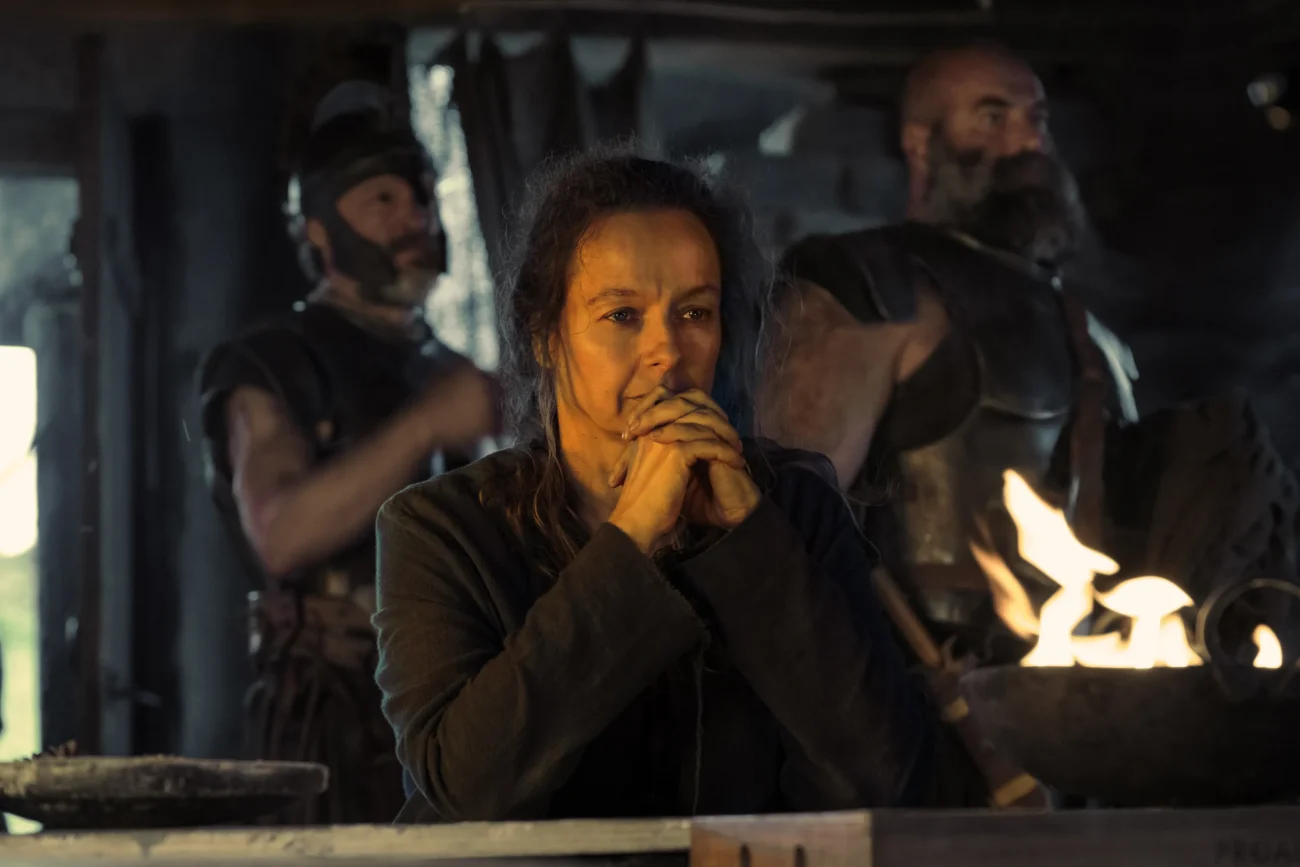
Nolan has praised Morton’s contribution to the role, and in an interview with the Los Angeles Times, he likened her performance in ‘The Odyssey’ to that of Heath Ledger’s in ‘The Dark Knight,’ stating she is someone who comes in and alters the dynamic of a massive film. Such comparisons have understandably heightened expectations for how significant Circe’s role will be.
Traditionally, Circe is portrayed as significantly younger, but Morton’s casting alters that dynamic, suggesting that this version of the character has encountered travelers like Odysseus long before this story begins and has grown resentful of them. Nolan reportedly described this update as providing an unsettling yet sympathetic humanization to a character often depicted more as an archetype than a fully realized individual.
The attention surrounding Morton’s portrayal of Circe is partly due to the ambitious scale of the production. ‘The Odyssey’ is the first feature-length film shot entirely on IMAX cameras, with cinematographer Hoyte van Hoytema and the crew developing new technology to address the format’s challenges. Principal photography was completed in just 91 days, finishing nine days ahead of schedule.
The film also features a remarkable ensemble cast beyond Morton and Damon, including Anne Hathaway as Penelope, Tom Holland as Telemachus, Zendaya as Athena, and Charlize Theron as Calypso, enriching Circe’s storyline among Homer’s most iconic characters. Matt Damon, who previously collaborated with Nolan on ‘Interstellar’ and ‘Oppenheimer,’ commended the director’s dedication to practical filmmaking without the use of green screens, noting that few filmmakers still attempt projects in this manner.
Given how central Circe’s island detour is to the structure of the original poem, her reimagined portrayal in Nolan’s adaptation could significantly influence how a new generation experiences one of mythology’s most intricate women.
Considering the murder some myths attribute to her and the jealous rage depicted in others, which version of Circe’s exile do you think Nolan’s film will explore, and are you eager to see Samantha Morton bring this darker, wearier interpretation of the sorceress to life on the big screen?