
Academics Weigh In on Christopher Nolan’s ‘The Odyssey’ and Their Insights Are Intriguing


Christopher Nolan’s ‘The Odyssey’ has quickly emerged as a significant cinematic event, and the academic response has added a compelling dimension to the discussion. While fans have been captivated by the film’s visuals, casting, and grand production, classicists and historians are examining how Nolan’s adaptation interprets one of the most renowned stories in literature.
Following a screening, a group of 17 scholars, historians, professors, editors, and public intellectuals convened to discuss Nolan’s take on Homer’s epic. This group featured Joel P. Christensen, editor of “The Oxford Critical Guide to Homer’s Odyssey,” alongside other experts who have dedicated years to studying ancient Greek literature.
Christensen noted that the overall feedback from the discussion was surprisingly positive, despite admitting he is often a tough critic due to his extensive background with Homer’s work.
“I was surprised by how many academics liked it,” Christensen remarked. He emphasized the importance of evaluating the film on its own merits, stating, “This is not Homer’s ‘Odyssey.’ This is Nolan’s ‘Odyssey.’ And it needs to be judged on different terms.”
One of the primary topics of discussion among the academics was how Nolan altered certain elements of the original narrative. They explored choices such as portraying Polyphemus, the iconic Cyclops, as a nonverbal being and the film’s exploration of themes like language, humanity, and survival.
For many scholars, the key takeaway was that Nolan was not aiming for a flawless historical depiction. Instead, they viewed the film as another interpretation of a tale that has been transformed and retold numerous times throughout history.
Monica Cyrino, a classics professor at the University of New Mexico with extensive experience in ancient worlds in film, remarked on the unusual excitement surrounding Nolan’s film.
“I’ve been in this business for a long time, and I don’t think I’ve seen anything like this,” Cyrino stated. She likened the buzz surrounding the film to the impact of the original Gladiator, suggesting that Nolan’s adaptation has sparked an even greater wave of interest prior to its release.
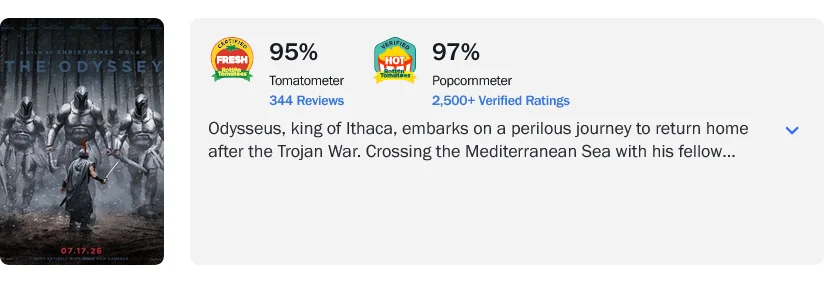
The scholars also touched on various online debates regarding the film, including casting criticisms and the historical accuracy of certain choices. However, many emphasized that these discussions were not the primary focus among the experts.
Christensen expressed that he was more intrigued by the themes and storytelling decisions than by debates over the film’s adherence to Bronze Age details.
“I’m really disturbed that so much of the conversation has been about how ‘woke’ or progressive this film was going to be,” Christensen stated. He contended that the film is more traditional in certain aspects, particularly regarding character portrayals.
Other experts highlighted that ancient Greek narratives have always been influenced by the cultures that retell them. Film critic Alonso Duralde pointed out that films depicting ancient history have never been entirely accurate reproductions.
“These are fictional characters,” Duralde noted. “There probably wasn’t actually a Helen of Troy. There probably weren’t actually a lot of these folks.” He added that the ancient world was likely much more diverse than many earlier Hollywood portrayals suggested.
Another significant point of discussion was Nolan’s approach to Homer’s language. Scholars explained that there has never been a single, definitive version of The Odyssey. The poem has evolved from an oral tradition and has undergone various translations and interpretations over millennia.
Stanford professor Richard P. Martin remarked that every generation crafts its own version of Homer’s tale.
“There is no ‘correct’ treatment, because every generation makes its own version of the poem,” Martin explained. He added that new adaptations keep the story alive and enable different audiences to connect with it.
The scholars also discussed notable translations of the epic, including those by Alexander Pope, Richmond Lattimore, and Emily Wilson. Each translator offered a unique style and interpretation, illustrating the challenges of capturing the full essence of Homer’s work.
Laura Slatkin, a Homer scholar at New York University, explained that no translation can ever be deemed the final version.
“None of them are definitive,” Slatkin stated. “That tells you something about the problem of translation, but it also tells you something about ‘The Odyssey’ because it’s not simple enough for a definitive translation.”
While some academics expressed concerns that Nolan’s film prioritizes action and spectacle over the deeper moral inquiries present in Homer’s original poem, many remain optimistic about its potential impact.
Justin Arft, a Homer scholar and associate professor at the University of Tennessee, Knoxville, remarked that the film could spark renewed interest in ancient literature.
“Honestly, we’re all curious — maybe confused, at times — but really interested in this as a piece of art. Nolan’s film is a piece of art, and Homer is a piece of art,” Arft said.
Cyrino believes that the greatest achievement of Nolan’s adaptation may be its ability to draw more people toward classic literature and history.
“What they don’t understand is the near-term and long-term benefit this has for us as a discipline,” she explained, noting that the film’s interest could encourage more students to enroll in classics programs.
For a story that has endured for nearly 3,000 years, another interpretation was always on the horizon. While Nolan’s version may not align perfectly with Homer’s, academics agree that maintaining the dialogue is crucial for keeping The Odyssey relevant across generations.
Have something to add? Let us know in the comments!