
Anne Hathaway Reflects on Her Regret Over ‘Becoming Jane’


Every actor has a performance they wish they could take back. For Anne Hathaway, an Oscar winner with a résumé full of crowd-pleasers, that film is surprisingly one of her most prestigious early projects. Her regret over ‘Becoming Jane’ has resurfaced, highlighting the challenges of portraying a literary icon.
Hathaway’s career took off in the early 2000s, largely thanks to her film debut in ‘The Princess Diaries’. Her role as Mia Thermopolis, a teenager who discovers her royal heritage, catapulted her to global fame. She reprised this role in the 2004 sequel and also starred in ‘Ella Enchanted’ that same year.
After a series of films aimed at younger audiences, she sought a change, which proved successful. Her performances in the Oscar-winning drama ‘Brokeback Mountain’ and the hit comedy ‘The Devil Wears Prada’ showcased her ability to tackle more mature material. The next challenge was an even bigger test: portraying Jane Austen herself.
In the 2007 film ‘Becoming Jane’, Hathaway took on the role of one of the most beloved and closely studied authors in literary history. Years later, she has described it as a film she finds difficult to discuss. In an interview with The Independent, she expressed that she felt she hadn’t fully captured the essence of the character and believed there was more she could have done.
She also admitted to feeling like she was overacting in certain scenes. This candid admission from a star typically praised for her work has sparked renewed conversation among fans. The comment stands out because it pertains to a film that was never a disaster, merely inconsistent.
The pressure was immense from the outset. Austen has a dedicated fan base that knows every detail of her life and work, and Hathaway was an American portraying an Englishwoman born in 1775. She has mentioned being obsessed with Austen since the age of 14, which only heightened the stakes.
Reports from that time indicate that the fear of failure nearly caused her to withdraw from the project. After filming concluded, she reportedly experienced panic attacks and nightmares. She also noted that the British public was initially resistant to her casting before they gradually accepted her.
Directed by Julian Jarrold and based on Jon Spence’s biography ‘Becoming Jane Austen’, the film chronicles a young Austen’s romance with Thomas Lefroy, portrayed by James McAvoy. The supporting cast included Julie Walters, James Cromwell, and Maggie Smith. The film premiered in UK cinemas on March 9, 2007.
Lefroy and Austen are said to have shared a brief flirtation in 1796, which did not last. About three years later, Lefroy married Mary Paul and had seven children, naming one daughter Jane, while Austen remained unmarried and childless. However, the film depicts their romance as a defining love story.
This creative choice divided Austen enthusiasts. Many felt the film portrayed her as a version of Elizabeth Bennet, the heroine of ‘Pride and Prejudice’, with Lefroy resembling a Mr. Darcy-like figure. Some critics focused on Hathaway’s nationality and accent, while others praised her warmth and charm.
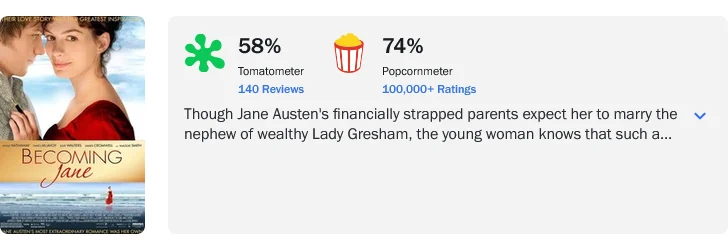
Critics were divided. The film received mixed reviews and grossed approximately $37 million worldwide, a modest outcome for a project with such a strong cast. Hathaway did receive a nomination for Best Actress at the British Independent Film Awards.
It also debuted just two years after Joe Wright’s well-received adaptation of ‘Pride and Prejudice’, which set a high standard for Austen-related films. Given this context, ‘Becoming Jane’ was always going to face harsh scrutiny. Even its supporters often described it as pleasant yet fanciful.
What makes Hathaway’s reflection so relatable is its honesty. She isn’t blaming the script, the critics, or the Austen purists. Instead, she is taking responsibility, which is a refreshing change in an industry where actors typically defend every choice.
This also illustrates how much the role meant to her. A performance she still contemplates nearly two decades later was clearly more than just another job. For a performer who has since won an Oscar and led major franchises, it serves as a humbling reminder that growth often arises from roles that didn’t go perfectly.
Have something to add? Let us know in the comments!