
Christopher Nolan’s ‘The Odyssey’ Ending Explained and Why Odysseus Might Not Have Survived


Ten years away from home is a significant stretch, and Christopher Nolan ensures that viewers feel every moment of that absence. His latest adaptation of ‘The Odyssey’ has finally debuted in theaters worldwide this week, wrapping up a marketing campaign that had fans eagerly analyzing trailers for months.
The film reinterprets Homer’s ancient poem through Nolan’s signature nonlinear storytelling, alternating between Telemachus growing up without his father in Ithaca and Odysseus facing monsters, gods, and his own guilt on the treacherous sea. Matt Damon stars as the weary king, with Anne Hathaway portraying Penelope and Tom Holland as his son Telemachus.
However, as the credits roll, the narrative does not conclude neatly. Odysseus finally returns home, but the film intentionally leaves his fate ambiguous, sparking much discussion among viewers. Guided by the shade of Agamemnon in the underworld, Odysseus enters his palace in disguise, only to find it overrun by suitors, the most dangerous being Robert Pattinson’s Antinous, who has already conspired to kill Telemachus.
Disguised as a beggar, Odysseus reconnects with his loyal ally Eumaeus and secretly reveals his identity to Telemachus before the assassination can take place. In a poignant moment, he confesses to Penelope, who still does not recognize him, expressing his guilt over violating Zeus’s law with the Trojan Horse, explaining how that act of deception shattered something sacred that upheld the old order of civilization.
Penelope, testing the suitors, sets a challenge that only her true husband could accomplish: stringing Odysseus’s old hunting bow and shooting an arrow through twelve axe heads. Each suitor fails until the disguised beggar steps forward, completes the challenge, and reveals his true identity.
What follows is a brutal battle within the palace. Odysseus kills Antinous and Corey Hawkins’s Polybus, while Telemachus takes down the treacherous Melanthius. The remaining suitors surrender, and the disloyal maidservant Melantho, played by Mia Goth, is executed for her betrayal. Although it is a decisive victory, Odysseus does not emerge unscathed, suffering several arrow wounds that leave him severely injured.
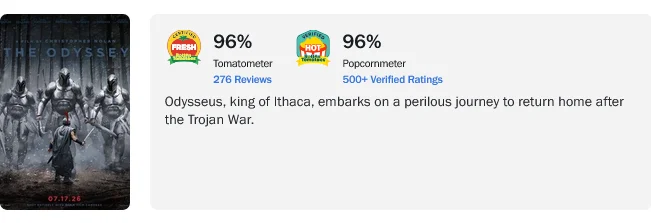
This is where Nolan diverges most sharply from Homer’s original text. The poem provides Odysseus with a clear, triumphant return, but the film leaves it uncertain whether he survives his injuries. Instead of reclaiming his throne, Odysseus opts to pass his kingdom to Telemachus and sails away into exile with Penelope, seeking peace after years of turmoil and regret.
Zendaya’s portrayal of Athena adds another layer to this unresolved narrative. Her presence throughout the film is later connected to a Trojan priestess whose death Odysseus witnessed as Troy fell, recasting the goddess who has guided him as a manifestation of his own unresolved guilt.
Critics have interpreted this ending as a deliberate choice, suggesting that ‘The Odyssey’ is less focused on a neat victory and more on portraying a man unable to escape the consequences of his actions to return home. This interpretation aligns with Nolan’s broader filmography, where triumph and sacrifice often coexist, much like in ‘Oppenheimer.’
Whether Odysseus lives, dies, or simply chooses to fade into the horizon is left for the audience to determine, and this open-endedness appears to be the film’s central theme. It transforms a nearly three-thousand-year-old story into one that still feels unresolved.
Have something to add? Let us know in the comments!