
Only Nolan Can Do It: The Fall of Troy in ‘The Odyssey’ Filmed Without Green Screen


Christopher Nolan has consistently avoided digital shortcuts throughout his career, and ‘The Odyssey’ exemplifies this philosophy taken to its most extreme level. Featuring everything from puppet Cyclopes to fully practical giant battles, the film serves as a true testament to what traditional filmmaking can achieve in a landscape dominated by CGI.
This commitment to authenticity reached its zenith during one of the film’s most crucial scenes, the fall of Troy. Instead of relying on visual effects to depict this iconic moment from mythology, Nolan opted to construct the entire sequence using real materials, fire, and actors in tightly packed spaces.
For the fall of Troy, the production team created over 1,000 custom four-foot LED panels known as Pyrohedrons. These panels were programmed to mimic natural flame flicker profiles, illuminating set pieces from up to a mile away while avoiding the fire hazards associated with real flames. This kind of analog problem-solving defined the approach taken in nearly every major sequence of the film.
The Trojan Horse itself was an even larger physical challenge. Multiple 35-foot tall horses were constructed for the film, with one even submerged on a beach to allow real men to physically pull it from the sand and roll it into position, all captured on camera for authenticity.
Filming the sequence inside the horse turned into an improvised and claustrophobic experience for the cast. Matt Damon recounted asking Nolan the day before filming how they planned to shoot the scene, only to be told, according to what Damon shared with GamesRadar+, that they would simply cram inside and figure it out together.
This lack of pre-planning resulted in a chaotic yet genuinely organic shoot. John Leguizamo, who portrays Odysseus’s companion Eumaeus, described searching for Nolan on set only to find the director, cinematographer Hoyte van Hoytema, and an IMAX camera squeezed inside the wooden structure with 20 actors, all collaborating in real time to capture the moment.
Damon has extensively discussed the physical toll of that shoot, noting that the claustrophobia felt by audiences was a natural result rather than just performance. He described watching van Hoytema peer through the lens while Nolan stood beside him, building the scene from scratch within the cramped space.
This particular sequence had been on Nolan’s mind for decades, dating back to when he was briefly attached to direct 2004’s ‘Troy’ before the project ultimately went to Wolfgang Petersen. Nolan has mentioned carrying the image of the horse sinking into the sand in his mind for nearly 20 years before finally having the chance to bring it to life.
This level of dedication was evident throughout the entire production, which lasted 91 days and spanned six countries, including Italy, Iceland, Greece, Morocco, and Scotland. The film’s Trojan set alone covered over 110,000 square feet and could accommodate more than 2,000 extras, featuring a recreated temple of Athena built directly into the tiered hillside city.
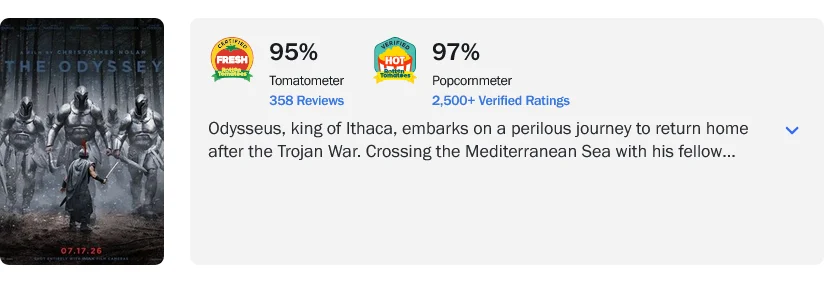
With ‘The Odyssey’ continuing to perform strongly at the box office weeks after its release, this behind-the-scenes commitment to practical filmmaking has clearly struck a chord with audiences eager to see something authentically constructed rather than digitally created. Given the physical risks and improvisation involved in capturing this single sequence, it stands as one of the most remarkable examples of how far Nolan is willing to go for authenticity on screen.
Have something to add? Let us know in the comments!