
Paul Greengrass Discusses His Inspiration Behind ‘The Uprising’ and the Peasants’ Revolt


Paul Greengrass has dedicated his career to crafting films that highlight ordinary individuals caught in extraordinary historical events, from the hijacking of a plane on September 11 to a cargo ship taken by Somali pirates. His latest endeavor takes this fascination further back in time, immersing him in the turmoil of 14th-century England.
‘The Uprising‘ narrates the Peasants’ Revolt of 1381, one of the most significant and violent insurrections in English history. During this tumultuous period, thousands of farmers and laborers rose against the Crown after enduring the burden of a harsh new tax. Andrew Garfield stars as a grieving farmer known simply as the Ploughman, serving as a fictional lens through which the rebellion, centered around actual historical figures, is explored.
In discussing what attracted him to this project, Greengrass referenced the grand historical epics he cherished growing up, films that depict ordinary people confronting injustice at great personal risk. This same instinct influenced iconic films like ‘Gladiator’ and ‘Braveheart,’ and Greengrass aims for ‘The Uprising’ to resonate with that tradition of impactful, character-driven historical storytelling.
This ambition is reflected in the film’s historical authenticity. Cosmo Jarvis portrays the renowned leader Wat Tyler, while Jamie Bell takes on the role of the radical clergyman John Ball, with Thomasin McKenzie completing the rebel cast. This ensemble gives the film a documentary-like foundation, even as Garfield’s fictional Ploughman carries much of the emotional narrative.
Greengrass has also articulated why he believes this centuries-old revolt holds significance beyond a mere history lesson. In a conversation with NPR’s Fresh Air, he noted that while the Peasants’ Revolt was ultimately suppressed, the ideals behind it endured, surviving through stories shared in taverns and village squares about legendary figures who defied authority.
This connection extends beyond folklore. Greengrass pointed out that the legend of Robin Hood emerged during this same era, as both narratives reflect a society starkly divided between wealth and poverty. Focus Features has embraced this connection in its marketing, recently rebranding the film with the tagline “Witness the Rise of Robin Hood.”
Greengrass has drawn striking parallels between the film’s medieval backdrop and contemporary society. In that same interview, he highlighted a pervasive sense of “great rage” simmering in modern times, which he believes resonates with recent events like the Capitol riots, framing the comparison more as a reflection of collective frustration than a specific political stance.
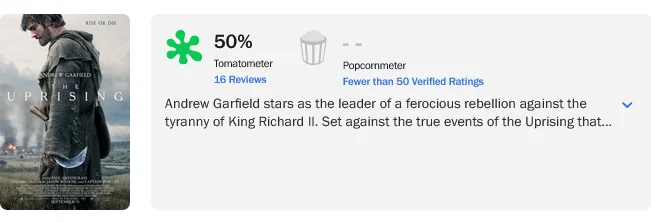
The film’s ensemble cast mirrors the scale of Greengrass’s ambition, featuring Garfield alongside Jamie Bell, Stephen Dillane, Tom Hollander, Cosmo Jarvis, Thomasin McKenzie, Jonny Lee Miller, Woody Norman, and Katherine Waterston. Produced by Jason Blum through Blumhouse, known primarily for horror, the film also includes contributions from Gregory Goodman, Joanna Kaye, Greengrass himself, Lars Sylvest, and Joe Neurauter.
It’s noteworthy that ‘The Uprising’ marks Greengrass’s second release in a brief period, following his recent Apple TV film ‘The Lost Bus’ starring Matthew McConaughey. Across both projects, the director continues to explore themes of institutions under pressure and the choices ordinary people must make when history calls.
‘The Uprising’ is set to hit theaters on September 11, providing audiences with their first comprehensive look at whether Greengrass’s medieval epic can fulfill the historical grandeur he aims to achieve.
Have something to add? Let us know in the comments.