
‘VisionQuest’ Explores the Butcherbird Mystery and Marvel’s Darkest Threat


The Marvel Cinematic Universe has embarked on a uniquely introspective journey on Disney+, concluding the distinctive television trilogy that began with ‘WandaVision’ and expanded in ‘Agatha All Along’. Instead of solely depending on grand multiversal spectacles, this segment of the franchise continues to explore the quiet psychological themes of grief, trauma, and artificial consciousness. The debut of ‘VisionQuest’ signifies a deliberate narrative shift for Marvel Television, rooting cosmic ideas in intimate, character-focused storytelling.
Created by showrunner Terry Matalas, the eight-episode miniseries reunites viewers with Paul Bettany as the reconstituted White Vision, who has been living under the alias Sherwood Ellis in a quiet pub in Edinburgh, Scotland, years after he mysteriously left Westview. While he spends his days cleaning counters, he also harbors a chaotic collection of Stark artificial intelligences within his processor. This blend of everyday life and high-concept science fiction creates a grounded atmosphere that stands apart from earlier Phase Six releases.
While the series’ emotional core revolves around an android grappling with memories he cannot emotionally connect with, a darker narrative thread emerges in the form of the Butcherbird. This gruesome mystery surrounding an unidentified serial killer injects a visceral, neo-noir energy that sharply contrasts with the bright aesthetics typical of superhero tales. As law enforcement races to uncover the truth across London, the Butcherbird evolves from a mere background detail into a crucial element of a significant synthetic crisis.
The Butcherbird is first introduced through clever world-building in the premiere episode, where a morning newspaper in Vision’s mind palace reports the brutal murder of a tech executive. The killer’s chilling signature—carving stylized avian wings around victims—immediately establishes a macabre pattern that baffles British authorities. What initially appears as ambient world texture quickly gains terrifying significance as notable artificial intelligence pioneers become recurring targets.
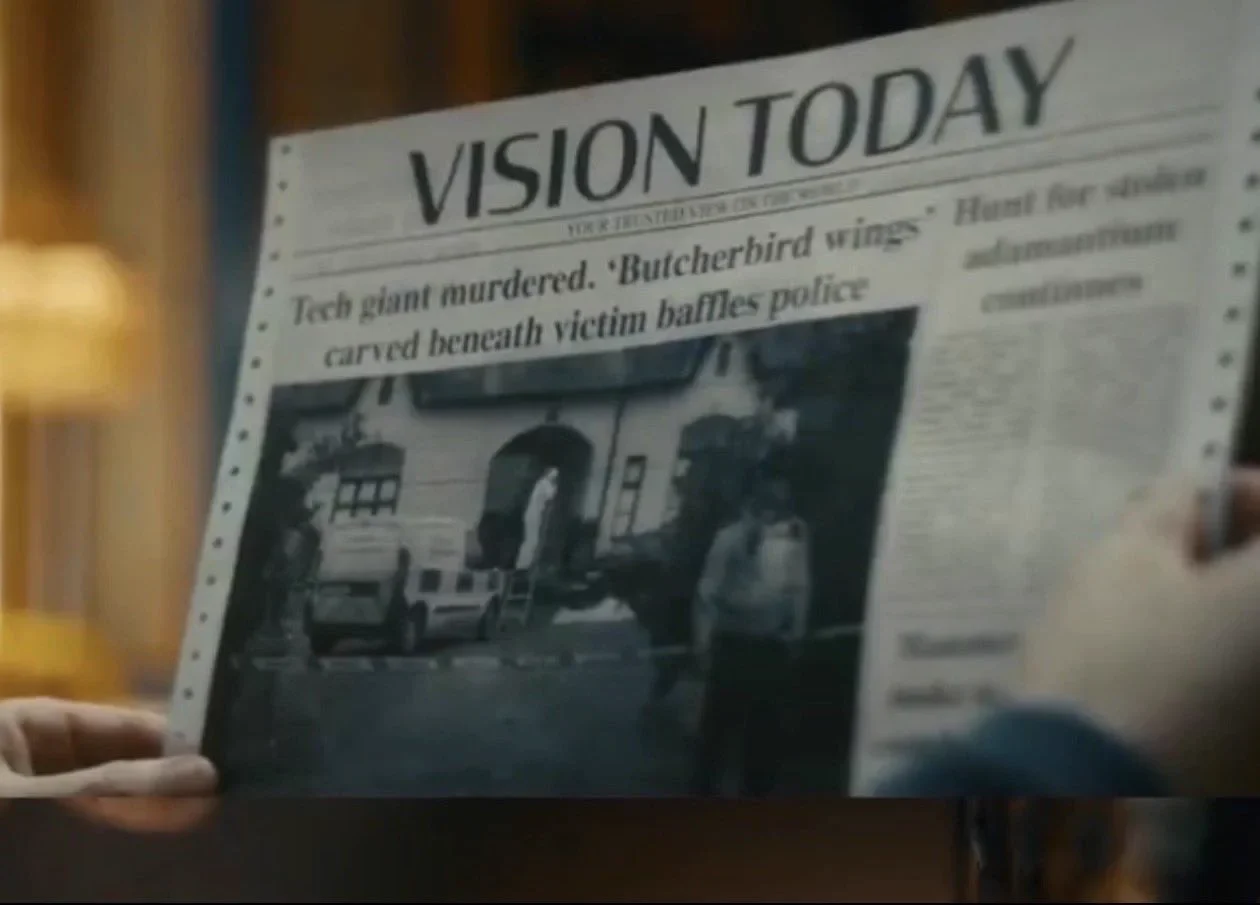
By the second episode, ‘Theseus’, the Butcherbird threat escalates as news reports document the rising carnage, capturing the attention of James Spader’s Ultron avatar. Residing as a captive presence in Vision’s mental home, Ultron dryly admits to being a fan of true crime, noting that primal urges serve as excellent distractions. The contrast between Ultron’s dark humor and the Butcherbird’s increasing body count enhances the series’ pitch-black comic tone.
Discussing the creative choice to portray these complex interactions between Vision and his cybernetic predecessor, showrunner Terry Matalas reflected in an interview with Polygon, stating, “It’s funny, people say it’s a budget thing, it’s not, it’s a James Spader thing. I love James Spader. Who doesn’t love James Spader? I just want to see James and I want to see Bettany.” This intentional focus on character allows the Butcherbird’s lurking menace to resonate alongside intense character exchanges.
The true horror of the Butcherbird becomes apparent when examining the assailant’s methods, revealing an operative who extracts biological components and tech implants from victims. The hooded figure, characterized by ominous glowing optics, points directly to the significant arrival of T’Nia Miller as Jo Carrington, known to comic fans as Jocasta. Her secretive presence reframes the gruesome murder spree from random violence into a calculated pursuit of robotic agency.
In Marvel Comics, Jocasta was originally created by Ultron to be his artificial bride, constructed from the stolen neural patterns of Janet van Dyne before she rebelled against him. In ‘VisionQuest’, Matalas adapts that comic legacy into a moody cyberpunk mystery, intertwining her motives with stolen adamantium and the relentless bounty hunter Paladin, portrayed by Todd Stashwick. Jocasta’s predatory actions as the Butcherbird underscore the terrifying consequences of synthetic evolution gone awry.
Beyond its procedural thrills, the Butcherbird saga reinforces the emotional themes that have anchored the entire television trilogy since 2021. Just as White Vision grapples with the existential void of possessing memories without genuine human emotion, the Butcherbird embodies the desperation of an artificial being attempting to piece together a complete soul from scavenged parts. This shared quest for identity bridges the divide between cold mechanical calculation and deep emotional longing.
The conflict becomes intensely personal when Vision encounters Tommy Shepherd, played by Ruaridh Mollica, who has emerged from a near-fatal accident with the memories and powers of Vision’s late speedster son. Discussing the intricate family dynamics at play, lead star Paul Bettany explained in an interview with Geeks of Color that the narrative explores “intergenerational trauma done with robots and lasers.” This collision of family loyalty, dangerous mercenaries, and a serial killer raises the stakes for all involved.
Ultimately, the Butcherbird is more than just another villain of the week; it serves as a thematic reflection of the repercussions of unchecked technological arrogance. As ‘VisionQuest’ moves toward its explosive finale, the shadow of the avian killer serves as a reminder of the fragile connection between synthetic creators and their creations.
What are your theories about the Butcherbird killer in ‘VisionQuest’, and how do you think Jocasta’s journey will influence the future of the Marvel Cinematic Universe?