
Were the Trojan War and Trojan Horse Real? Historians Explore ‘The Odyssey’s’ Iconic Moments


The concept of Greek soldiers concealing themselves within a massive wooden horse to infiltrate Troy has captivated audiences for centuries, making it one of the most recognizable symbols in Greek mythology. However, historians, archaeologists, and fans of ‘The Odyssey’ often wonder if there is any truth behind this legendary tale.
The answer is multifaceted. While certain elements of the legend seem to be based on a real historical conflict, other aspects, including the horse itself, are likely fabrications.
Archaeological discoveries in Turkey indicate that the city of Troy did exist, although the epic’s portrayal of a decade-long siege may not align with historical reality. The ruins identified as ancient Troy are located at a site known as Hisarlık, and this identification is widely accepted by most archaeologists and classicists today.
Excavations at this site began in 1863 with Frank Calvert and were later popularized by Heinrich Schliemann, who started his work in 1871. His efforts confirmed the existence of the legendary city, despite some damage to archaeological layers due to his aggressive digging techniques.
Recent excavations have uncovered additional evidence, such as Bronze Age sling stones and weapons dating back approximately 3,200 to 3,600 years, aligning with the timeframe of the legendary war. There is also proof of a fire that significantly damaged the city around 1190 to 1180 BCE, which corresponds closely with the timeline ancient writers attributed to Troy’s fall.
Cuneiform tablets from the Hittite civilization reference a conflict involving a city called Wilusa and a group known as Ahhiyawa, terms that some scholars link to Troy and the Achaean Greeks. This detail suggests a potential historical basis for the myth.
Despite the physical evidence, most historians refrain from endorsing the complete Homeric narrative. Many scholars agree that the Trojan War is rooted in a historical event involving a Greek expedition against Troy, yet few assert that Homer’s poems accurately depict the actual occurrences of the war.
One challenge lies in the timeline. If a Trojan War did occur, it likely took place in the thirteenth or early twelfth century BCE, while Homer composed ‘The Iliad’ approximately four centuries later, drawing from oral traditions that had been altered and dramatized over generations.
Some researchers have noted an intriguing detail in the archaeological record that complicates the narrative of a straightforward Greek victory. Evidence of a fire, human remains, and numerous sling bullets have been found, suggesting that a defending population would typically have collected their sling bullets for future use, while a victorious force would likely have left them behind.
Figures like Helen are generally regarded as fictional by most historians, although she may have been inspired by a real noblewoman from that era.
This is where the legend diverges from the evidence. Historians largely agree that while the Trojan War is based on real conflicts, the wooden horse is seen as a literary invention by Homer.
One popular theory posits that the wooden horse may have actually represented a siege engine or battering ram, as war machines of that time were often named after animals and wrapped in wet hides for protection against fire. This detail could have inspired the iconic image of a “horse” breaching Troy’s walls.
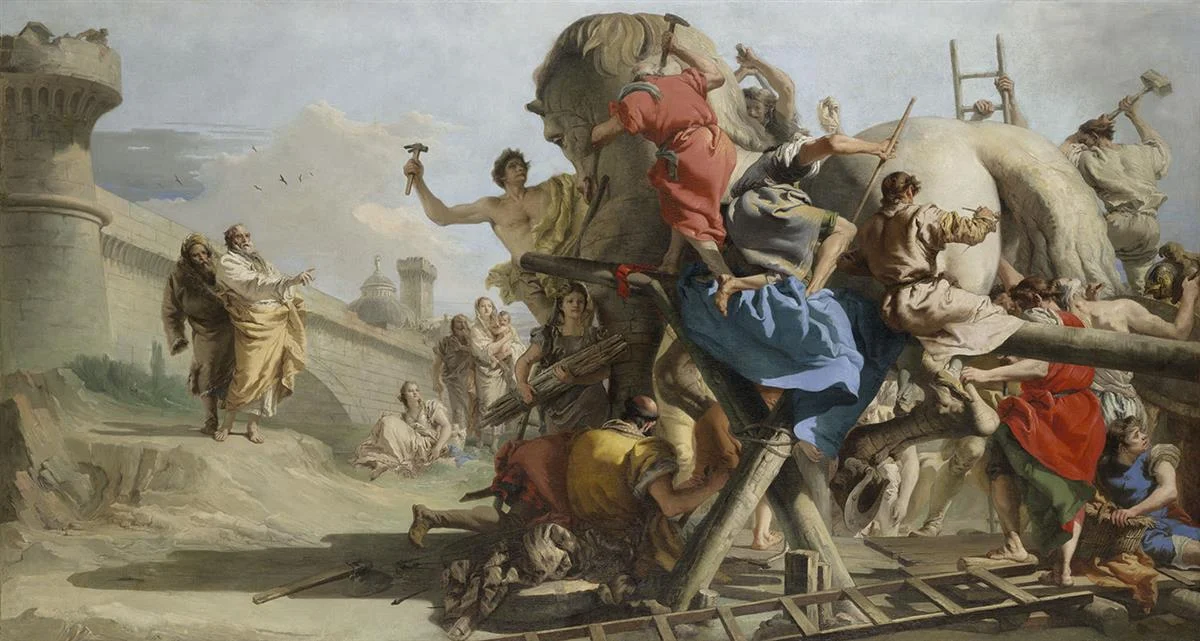
Another theory connects the horse to natural disasters rather than warfare. Some speculate that the horse symbolizes an earthquake, as Poseidon, the Greek god of both horses and earthquakes, is depicted in mythology as favoring the Greeks during the war. In this interpretation, the “gift” that toppled Troy’s walls was seismic activity rather than a clever Greek ploy.
There is also a symbolic interpretation worth noting. The Trojans were often described as “tamers of horses” in ancient texts, and Homer may have employed the wooden horse as a literary device to signify the subjugation of the Trojan people rather than as a literal object.
It’s important to remember that the Trojan Horse does not appear in ‘The Iliad’ and is only briefly mentioned in ‘The Odyssey’, with the most detailed account coming from the Roman poet Virgil in ‘The Aeneid’ centuries later. This alone highlights how the story evolved and transformed over generations and cultures.
For those who grew up with ‘The Odyssey’, the notion that the horse might be more metaphorical than mechanical does not diminish the story’s allure. Instead, it adds depth to an already intricate myth, where a poet may have woven together memories of an earthquake or a siege weapon into one of the most enduring images in Western storytelling.
What do you believe truly brought down the walls of Troy—a wooden horse, a battering ram, or a force of nature?