
Who Kills Odysseus in Greek Mythology and Why Nolan’s ‘The Odyssey’ Omits It


Christopher Nolan’s ‘The Odyssey‘ has left audiences pondering a significant question that diverges from the typical discussions about the Trojan Horse or the suitors. This inquiry revolves around the events that unfold after the film concludes, as Homer’s original narrative continues beyond the film’s ending.
Released on July 17, 2026, and featuring Matt Damon as the iconic king of Ithaca, the film wraps up on an ambiguous note, prompting fans to delve into the darker aspects of the mythology. This exploration leads directly to the query of who ultimately kills Odysseus, revealing a tale more bizarre than what was presented on the IMAX screen.
Nolan’s adaptation chronicles Odysseus’s ten-year journey back from Troy and his efforts to reclaim his kingdom from Penelope’s suitors. The film concludes similarly to Homer’s poem, showcasing Odysseus disguised as a beggar, testing the suitors, and ultimately reuniting with Telemachus to trap those attempting to usurp his throne and wife.
However, the film diverges from tradition in its closing moments. After vanquishing the suitors vying for Penelope’s affection, Odysseus finds himself exiled from Ithaca instead of comfortably resuming his reign. He opts for exile, sailing west to honor his fallen comrades.
The final scene is intentionally ambiguous. Odysseus collapses in Penelope’s arms, assuring her that he promises not death, but exile, before he is next depicted aboard their ship, bandaged and sailing toward the setting sun. This imagery has sparked debates among fans regarding whether the sunset voyage should be interpreted literally or symbolically.
In short, Odysseus does not die at the film’s conclusion. Various analyses of the ending suggest that survival, rather than death, is the ultimate fate of Odysseus within the film’s runtime. The exile serves as a form of punishment and penance rather than a fatal conclusion.
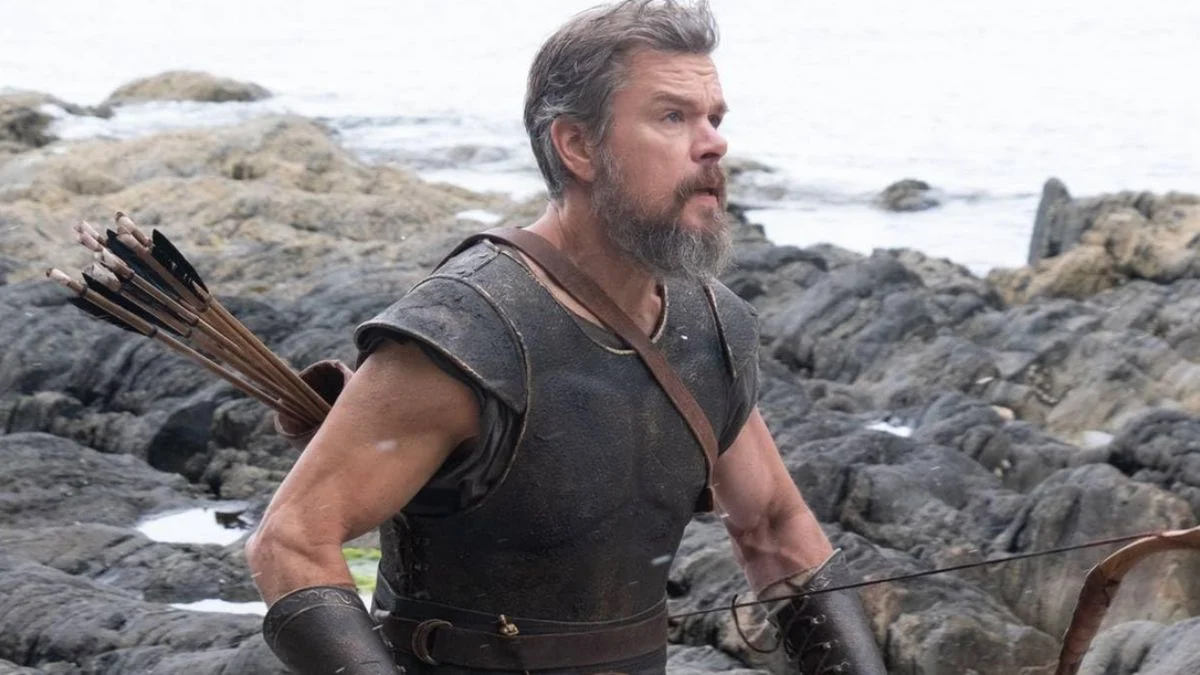
Nonetheless, Nolan leaves room for interpretation. The west is traditionally associated with the realm of the dead in Greek mythology, and given the severity of Odysseus’s injuries, some viewers argue that the voyage could symbolize something deeper rather than being taken at face value. This intentional ambiguity aligns with Nolan’s previous film endings.
Additionally, the film alters how Penelope recognizes her husband. Instead of the marriage bed test from Homer’s narrative, Penelope identifies Odysseus through an icon he possessed, a change that fans of the source material have begun to analyze online.
While the film does not address this, Homer’s original epic is not the final word on Odysseus’s fate. A different, stranger poem titled ‘The Telegony’ continues the story where ‘The Odyssey’ concludes, revealing one of the most ironic twists in Greek mythology.
According to this ancient text, Odysseus meets his end at the hands of Telegonus, his son with the sorceress Circe, during a dispute over cattle that Telegonus was unaware involved his father. The irony is that this death was foretold; Telegonus fatally strikes Odysseus with a spear tipped with a venomous stingray, fulfilling the prophecy that Odysseus would die by the sea.
The confusion arises because Circe sent Telegonus to Ithaca as an adult to summon Odysseus home. However, Telegonus mistakenly identifies the island as Corcyra and begins plundering it. Odysseus, unaware that the intruder is his own son, rushes out to defend his land, leading to a tragic confrontation.
An oracle had predicted that Odysseus would be killed by his own son, which is why Telemachus was previously banished from Ithaca as a precaution, only for the real threat to emerge from a son no one in the family knew existed.
The aftermath of this mistaken killing is equally bizarre. Telegonus takes his father’s body back to Circe’s island, accompanied by Penelope and Telemachus. Once there, Circe grants the surviving family immortality, with Telegonus marrying Penelope and Circe marrying Telemachus. This tangled resolution starkly contrasts with the dignified ending presented in Nolan’s film.
Some later traditions add even more complexity. One version introduces Cassiphone, a daughter of Odysseus and Circe, where Telemachus marries Circe but ultimately kills her after a quarrel, prompting Cassiphone to seek revenge by killing Telemachus. This tragic family tree is never hinted at in Homer’s original poem.
Nolan’s film was always intended to conclude where ‘The Odyssey’ poem does, as ‘The Telegony’ survives only in fragments and summaries, making it a challenging text for adaptation. Classics scholar Jonathan Burgess has pointed out that it remains uncertain whether ‘The Odyssey’ even acknowledges ‘The Telegony’ as a continuation, given the ambiguous relationship between the two texts.
This uncertainty renders ‘The Telegony’ a poor choice for a major summer film, but it also sheds light on why the ambiguous ending of Nolan’s film has generated so much intrigue. Once audiences learn that the mythology technically continues beyond the final scene, culminating in a son inadvertently killing his father, the open-ended sunset voyage takes on a much heavier significance than it did in theaters.
So, which interpretation of that final scene resonates more with you: a hero sailing toward genuine survival or a director subtly nodding to the darker myth lurking just beyond the frame?